10-Year Treasury Yield Hits 19-Year High as Oil, Inflation and Fed Comments Drive Spike
09/27/2026 / By Sterling Ashworth

The 10-year Treasury note yield rose more than 13 basis points to 5.104% on Wednesday, Sept. 23 – reaching a level not seen since July 2007, according to CNBC.
The benchmark yield’s move marked its biggest one-day increase since April 7, 2025, when it surged 16.6 basis points. The 2-year Treasury note yield, which is most sensitive to expected changes in Federal Reserve policy, jumped more than 11 basis points to 4.889%, hitting its highest level since May 2024, the report stated. The 30-year Treasury yield gained more than 9 basis points to 5.398%, reaching its highest level since June 2007.
Market participants attributed the sharp move to four factors: stronger-than-expected U.S. economic surveys, hawkish commentary from a Federal Reserve official, weak demand at a Department of the Treasury auction of five-year notes and stubbornly high oil prices. The 10-year yield’s push above the key 5% level gained steam throughout the trading session.
Strong PMI Surveys and Rising Oil Prices Add Pressure
S&P Global’s services purchasing managers’ index jumped to 58.7 in September from 56.5 in August, according to the firm. The reading was the highest in nearly five years.
The manufacturing PMI rose to 56.7, a level not seen in more than four years. PMIs are surveys of managers across different sectors of the economy.
“U.S. business continues to boom,” said Chris Williamson, chief business economist at S&P Global Market Intelligence, in a statement. “To put the growth surge in context, barring the spike in demand following the opening up of the economy after the COVID-19 [Wuhan coronavirus] lockdowns, the latest improvement in business activity is the greatest recorded since early 2015. Business is clearly booming now in both manufacturing and services.”
Williamson added that input costs jumped in September at the steepest rate in four years, with fuel and transport costs spiking higher due to rising oil prices. Brent crude futures rallied 3.86% to settle at $103.08 per barrel, while U.S. crude gained 1.81% to settle at $92.16 per barrel, CNBC reported. Oil prices have soared this year as the U.S.-Iran war continues, sparking fears of persistent inflation that could force additional Federal Reserve rate hikes.
Fed Official Comments and Rate-Hike Odds Climb
Comments from Federal Reserve Gov. Michael Barr added further upward pressure on yields. “In my base case, further policy adjustments are likely to be needed to ensure inflation comes down to target in a timely fashion,” Barr said. “We want to support sustainable, durable growth in support of maximum employment, and price stability is crucial to that.”
Following the first Fed rate hike in more than two years last week, odds of another quarter-point rate increase in October rose Wednesday to 66.4% from 55% a day earlier, according to CME Group’s FedWatch tool. Those chances stood at less than 10% a month ago, the report stated. The Federal Open Market Committee raised its target range by 25 basis points to 3.75%–4.00% on Sept. 16 – its first hike after a run of cuts, citing inflation that Fed Chair Kevin Warsh called “too high and has been for too long” [1].
Tony Miano, global investment strategy analyst at Wells Fargo Investment Institute, described the market’s reaction as a fundamental shift in expectations. “This is the market telling us we’ve entered a genuine re-tightening cycle,” Miano said. “The Fed’s 25 basis point hike last week to 3.75%–4% was its first increase since 2023, and the dot plot signaled another this year.”
He added: “A week ago you could argue that was a one-and-done insurance move or a one and maybe December hike. Today’s price action says investors no longer believe that.”
Weak Five-Year Treasury Auction Deepens Bond Selloff
Traders also contended with a much weaker-than-expected Treasury Department auction of five-year notes. According to BMO, the sale concluded with a yield of 5.033% – far above a six-auction average of 4.186%. Indirect bidders, which include global central banks, took 54% of the auction, well below a 65% average.
“Bottom line, a poor auction with Treasury trying to sell paper into a weak market and where yields weren’t attractive enough to bring in the buyers,” Peter Boockvar, chief investment officer at One Point BFG Wealth Partners, wrote in a Wednesday note. “The bond bear market continues on.”
The weak auction followed a broader pattern of deterioration in the Treasury market. A prior 20-year bond auction priced with a large tail and the lowest foreign demand on record [2].
Treasury bonds with maturities of 10 years or more have fallen by 46% since March 2020, according to prior reporting [3]. The persistent decline has left major financial institutions holding substantial unrealized losses on their bond portfolios, with Bank of America alone reporting $112 billion in unrealized bond losses, representing 57% of its tangible common equity [4].
What to Watch Next in the Bond Market
Miano said the path forward depends largely on whether the Federal Reserve can bring inflation under control. “You can’t fool or hide in the bond market – unless the Fed gets inflation under control the long end of the curve is going to continue to come under pressure,” he said.
Investors are watching oil prices, inflation data, and Federal Reserve policy signals for direction, according to market analysts. The yield on the 10-year Treasury breaking through 5% may influence borrowing costs across the economy, including mortgages, corporate debt and consumer credit.
Mortgage rates already climbed toward 7%, with the average contract rate on a 30-year fixed mortgage rising to 6.97% from 6.85%, its highest level since May 2025, according to the Mortgage Bankers Association [5]. The global dimension of the bond selloff has also drawn attention.
The 10-year Treasury briefly poked above 5% this week, peaking at 5.04% on Bloomberg‘s tape, the highest since 2007. Japan’s 10-year yield is above 3% for the first time in three decades, German bunds are at their highest in a decade and a half and U.K. gilts are at a post-2008 high [6]. The synchronized rise in sovereign yields suggests broad-based pressure on government debt markets worldwide, not merely a U.S. phenomenon.
References
- FreightWaves. “The Fed Just Raised Rates Again: Here’s What It Means for Freight.” FreightWaves.com. September 22, 2026.
- ZeroHedge. “Terrible 20Y Auction Prices With Huge Tail, Lowest Foreign Demand On Record.” ZeroHedge.com. September 15, 2026.
- NaturalNews.com. “Brace yourself: Ongoing Treasury bond collapse ranks among worst in market crash history – and the carnage has only just begun.” NaturalNews.com. October 9, 2023.
- Lance D Johnson. “Bank of America’s $112 unrealized bond losses highlight precarious state of U.S. banking system.” NaturalNews.com. January 20, 2025.
- NTD. “Mortgage Demand Drops as Rate Climbs Toward 7 Percent.” NTD.com. September 16, 2026.
- ZeroHedge. “These Are The Countries Where Bond Yields Are Rising Fastest.” ZeroHedge.com. September 21, 2026.
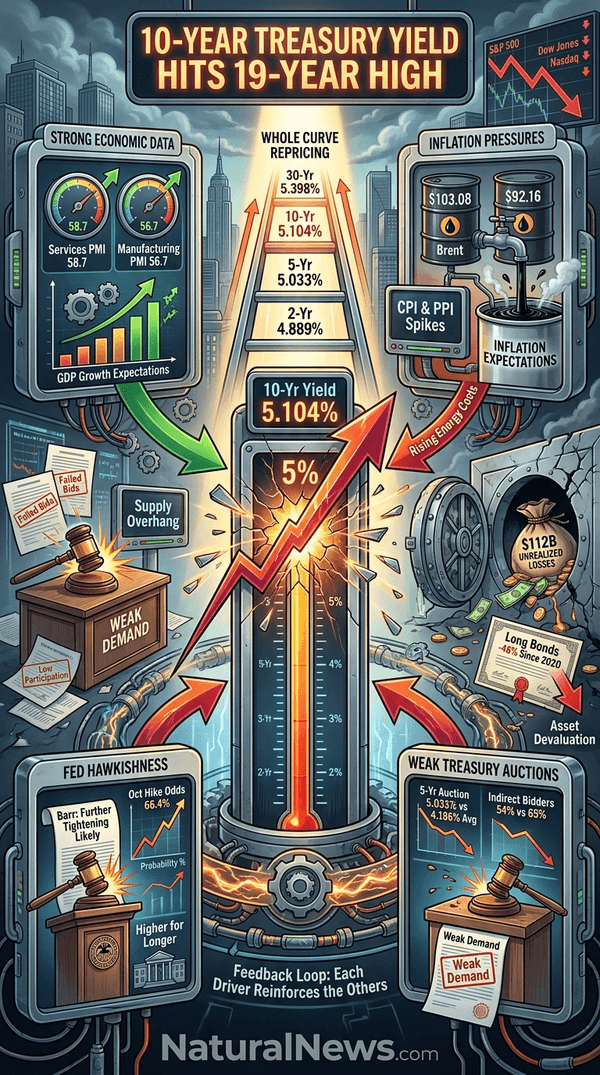
Explainer Infographic
Submit a correction >>
Tagged Under:
10-year yield, 2-year yield, 30-year yield, 5-year yield, bond auction, bond market, bond selloff, central banks, debt bomb, debt collapse, department of the treasury, Federal Reserve, German bunds, government debt, Inflation, interest rate, investing, Kevin Warsh, Michael Barr, money supply, oil prices, rate hikes, Treasury bonds, Treasury notes, UK gilts
This article may contain statements that reflect the opinion of the author
RECENT NEWS & ARTICLES